Setup via WPS
The process of adding a new device using the WPS (WiFi Protected Setup) is very similar to the setup via Wi-Fi. The only difference is that all the initial setup of the connection to the SH-GW is done via the WPS. The process of WPS is as follows: both SH-GW and new ED (end device) have to activate the WPS at the same time. After the WPS is activated, the client-side device negotiates access with the access point / SH-GW and after the Wi-Fi connection is set up, the rest is the same as in the setup via Wi-Fi example (as described in Setup via Guest WiFi).
Setup Steps
- MQTT Controller (Mobile/Web App) initiates the process of adding a new device by subscribing to /<home_id>/<gw_id>/add_device/in. Then it publishes an activation request containing activation code, device id, and device type to /<home_id>/<gw_id>/add_device/out. The activation code and device id codes can be found on the newly installed device as two unique numbers identifying the device (placed on a device label or inside a QR code).
- The user is prompted to activate WPS by pressing button on the SH-GW.
- MQTT ED then connects to the Home Wi-Fi and further utilizes mDNS (multicast DNS) to resolve address MQTT2GO.local (_mqtt._tcp.local.) and port, which equal to the address and port of local MQTT broker, respectively.
- The MQTT ED then connects to the local MQTT broker under the initialization account (only a pre-loaded certificate is used for login). The MQTT ED contains a pre-loaded certificate fingerprint of trustworthy CA (Certification Authority), which is used to establish TLS (Transport Layer Security) communication with the MQTT broker. The chain of trust must be on both sides. Thus, the SH-GW (MQTT broker) has to contain a certificate issued by the same CA as it is contained in the MQTT ED. If these certificates do not match, the TLS communication cannot be established, and the device will be refused as a non-trustworthy.
- When the TLS communication is established the MQTT ED subscribes to the <activation_code>/activation/in topic and publishes GET_CREDENTIALS request to <activation_code>/activation/out.
- As a response, SH-GW (local MQTT broker) generates a new set of certificates that will be used for ongoing communication and publishes its CA certificate, login, and password to the MQTT ED.
- When the MQTT ED receives the certificate and MQTT credentials from the <activation_code>/activation/in topic, connection under the initialization account to the local broker is closed.
- Further MQTT ED connects to the local MQTT broker with a certificate and credentials obtained in the step 6 and subscribes to <dev_id>/home/in. The certificate from the step 6 is directly connected to the device id. Thus only the device with proper device id value can utilize this certificate. This approach brings additional security to the device configuration process.
- In the next step, the MQTT ED publishes request of the home_prefix type to <dev_id>/home/out topic that contains all entities the ED provides with additional information on its data type and unit.
- The SH-GW publishes home_id and gw_id to <dev_id>/home/in. The MQTT2GO ED uses these prefixes to generate unique topics for each of its entities. As the local MQTT broker possesses information about all ED entities, it can generate topics on the local broker side.
- As a result, MQTT broker publishes the message to <home_id>/<gw_id>/add_device/in topic with device id information to distinguish individual devices. This message indicates to the controller that new ED was added to the system, and it is necessary to set a human-readable name and assign ED to the group(s).
- MQTT local broker then expects a message from MQTT Controller with the end device name, group, and device_id in <home_id>/<gw_id>/add_device/out topic.
- In what follows, the MQTT end device subscribes to its topic, and all ongoing communication happens according to the MQTT2GO standard.
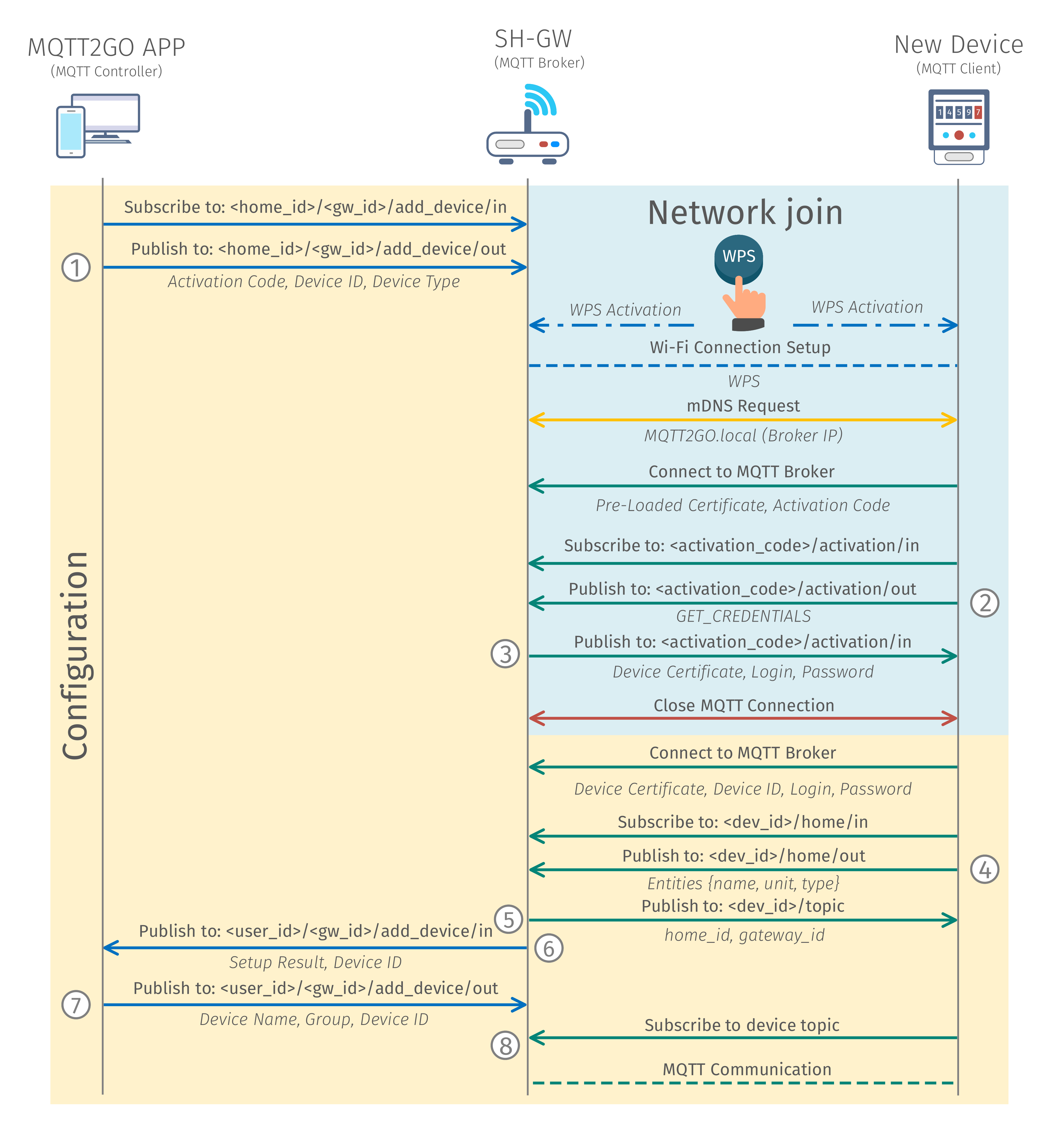
Fig. 1: Process of adding new MQTT2GO device utilizing WPS.
Network Join
The operation of adding a new device into the network / household is exploiting a special topics. These topics are only temporary and utilized only for this specific use-case.
Topics Structure
As aforementioned, network join topics are unique inside the MTT2GO standard and are solely used for the initial connection of new devices. Their structure is given in following subsections.
MQTT Commands
The MQTT commands for the network join are again based on the general structure from MQTT Commands. The most important difference is the value of the command, which can be further divided by the function of the command message (the numbering here corresponds to the one in Fig. 1).
Get Credentials
This command (2) is utilized to get a newly generated certificate for the end device. Its command value is in form of string with value GET_CREDENTIALS.
<activation_code>/activation/out
{
    "timestamp": "timestamp_value",
    "type": "mqtt_credentials",
    "value": "GET_CREDENTIALS"
}
MQTT Reports
These reports are specifically designed only for the network join. They follow the general structure from MQTT Reports, and they are labeled with numbers that correspond to the Fig. 1.
Credentials Report
This report (3) is utilized to deliver a newly generated certificate, password, and login from MQTT broker to the end device.
<activation_code>/activation/in
{
    "timestamp": "timestamp_value",
    "type": "mqtt_credentials",
    "value":  {
        "cert": "device_certificate",
        "user": "mqtt_login",
        "password": "mqtt_password"
    }
}
Device Configuration
The device configuration is happening over topics that are unique to this process only. To secure that the configuration will be done to the intended device, a unique device_ids is utilized during the process.
Topics Structure
The topics for the device configuration presented in this section are for the initial device configuration only.
MQTT Commands
The MQTT Commands mentioned below are used in adding a new device process. The command structure is based on the structure from MQTT Commands. Again, the numbering in this section is coherent with the numbering in Fig. 1.
Add New Device
This command (1) is utilized to start the whole process of adding a new device. The command contains the activation_code, device_id, and device_type of the newly added device.
<home_id>/<gw_id>/add_device/out
{
	"timestamp": "timestamp_value",
	"value": {
		"activation_code": "activation_code",
		"device_id": "device_id",
		"device_type": "device_type"
	}
}
Get Home Prefix
In case of Get Home Prefix (4), which is used to obtain the home prefix, that consists of home_id and gateway_id. The command value consists of array of the available topic names of the current device, together with unit name and type.
<device_id>/home/out
{
    "timestamp": "timestamp_value",
    "type": "home_prefix",
    "value": [
      {"name": "topic_name",
       "unit": "unit_quantity",
       "type": "unit_datatype"
      }, ...
    ]
}
Rename Device
This report (6) is utilized to request the user of the MQTT2GO Controller app for the name and group of the newly added device.
<home_id>/<gw_id>/add_device/in
{
	"timestamp": "timestamp_value",
	"value": {
		"device_id": "device_id",
		"setup_result": "setup_result"
	}
}
MQTT Reports
The MQTT reports presented here are designed as “responses” to aforementioned commands. Their structure is also coherent with the general structure from MQTT Reports and the numbering is matching the one in Fig. 1.
Home Prefix Report
The home prefix report (5) consists of home_id and gateway_id.
<device_id>/home/in
{
    "timestamp": "timestamp_value",
    "type": "home_prefix",
    "value": {
      "home_id": "home_id_value",
       "gateway_id": "gateway_id_value"
    }
}
Rename Device Report
This report (7) is utilized to finalize the process of adding a new device to the system. Via this report, the end device gains its name and inclusion to the groups.
<home_id>/<gw_id>/add_device/out
{
	"timestamp": "timestamp_value",
	"value": {
		"device_id": "device_id",
		"device_name": "device_name",
		"group_id": ["group_id_1", "group_id_2", ...]
	}
}